
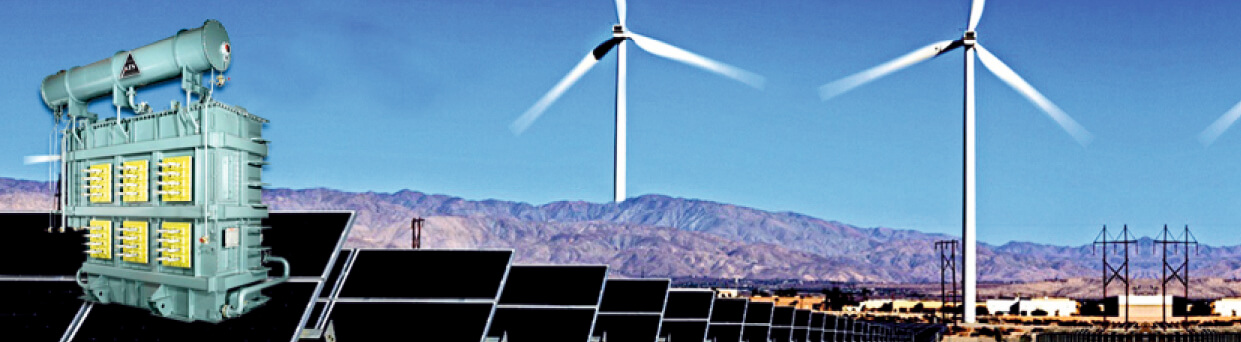
Solar Application:On utility-scale solar energy facilities, voltages are transformed after the inverter for delivery to the utility grid voltage. A transformer on a solar power facility is primarily used to step-up the voltage to deliver the renewable energy to the utility grid.
Multiple Windings on Primary Side:Multiple windings design on primary side of the transformer enables to connect multiple inverters to the grid with minor number of transformers in total. The precise requirements vary from device to device and from site to site. That’s why each transformer will be almost as unique as a fingerprint when it comes to voltage, power, climate efficiency, network topology, permissible noise level, and other factors. Earth Shield is provided between the HV & LV windings to reduce the harmonics & path to ground any residual resonance.
Wind Application:WIND power plants that are too large for direct connection to a local distribution system, are interconnected to HV or EHV transmission systems. Today, the vast majority of wind generation is interconnected to the utility grid at the transmission level. This interconnection is accomplished using one or more power transformers to step-up plant output, from the medium voltage level used for the plant’s collector system to the transmission system voltage level.
These transformers, along with switchgear, protective relays, metering, reactive compensation equipment (in some plant designs), and other equipment needed to perform the interconnection and control and protect the collection system, are located in a substation.